Hear Everything: Why Sound Design Is the Secret Weapon of Premium Adult Content
Close your eyes during your favorite scene. Really do it. What's left? If the production is doing its job right, you're still completely locked in — because the audio is carrying the experience just as much as the visuals ever did. But if the sound is muddy, hollow, or badly synced, the whole illusion falls apart in seconds.
At HD Mad Thumbs, we spend a lot of time talking about resolution, frame rates, and cinematography. And we should — visual quality matters enormously. But we've been sleeping on audio, and so has a big chunk of the adult entertainment industry. That's starting to change, and the difference it's making is genuinely striking.
The Problem Nobody Wants to Admit
Here's an uncomfortable truth about a lot of adult content, even content marketed as "premium": the audio is an afterthought. Productions will spend serious money on cameras, lighting rigs, and location scouting, then hand off sound to whoever's available with a cheap lavalier mic and call it a day.
The result? Dialogue that sounds like it was recorded in a bathroom. Ambient noise that pulls you right out of the moment. Levels that spike and drop unpredictably. It's the kind of thing your brain notices even when you can't consciously identify it — a low-grade irritation that chips away at immersion without you fully understanding why.
Sound technicians who've crossed over from mainstream film and television production into adult entertainment describe a culture shock. "In a conventional Hollywood production, the sound department has its own budget line, its own crew, its own post-production timeline," one audio engineer who's worked across both industries told us. "On a lot of adult sets, you're lucky if someone remembered to charge the wireless receiver."
What Good Audio Actually Involves
So what does professional sound design look like in practice? It starts way before anyone calls action.
Location acoustics are the foundation. Hard floors, bare walls, and low ceilings — common in residential shoots — create reverb and echo that are genuinely difficult to fix in post. Experienced sound engineers will walk a location before the shoot, clapping their hands, listening for flutter echo, and recommending acoustic treatment if needed. Even something as simple as adding rugs or hanging fabric panels can transform a room's sound profile.
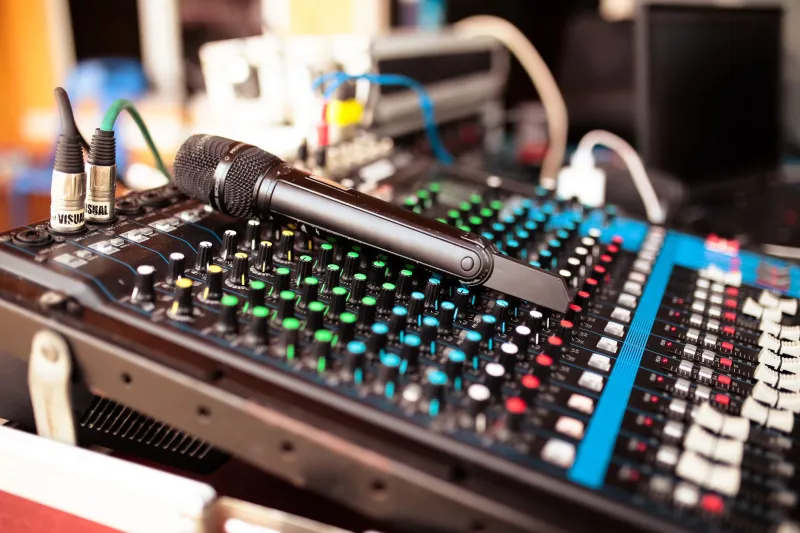
Microphone choice and placement is where a lot of productions go wrong. A boom mic operated by someone who knows what they're doing captures rich, directional audio that feels present and real. Wireless lavs are convenient but can introduce noise and compression artifacts. The best productions use a combination — boom for primary capture, lavs as backup — and have a dedicated sound mixer monitoring levels in real time.
Post-production mixing is where the magic gets finished. This includes dialogue cleanup using noise reduction tools, EQ adjustments to make voices sound natural and clear, and the layering of ambient sound to fill the space. That subtle background texture — room tone, environmental noise — is what makes a scene feel like it's happening somewhere real rather than in an acoustic void.
Why It Matters More Than You Think
Audio quality has a direct, measurable impact on emotional engagement. This isn't just subjective preference — it's basic psychoacoustics. The human brain processes sound and image simultaneously, and when they're out of sync or mismatched in quality, cognitive dissonance kicks in. Viewers feel uneasy without knowing why, and immersion suffers.
For adult content specifically, that immersion is everything. The whole point is to create a believable, engaging experience. A performer's vocal delivery — the timing, the texture, the naturalness of it — communicates as much as their physical performance. When that's captured cleanly and mixed well, it creates a level of presence that no amount of 4K resolution can replicate on its own.
This is why headphone listening has become such a significant factor in how platforms think about audio. A growing percentage of viewers are watching on phones and laptops with earbuds or quality headphones, and those setups expose every flaw in a bad mix. Tinny highs, boomy lows, off-center imaging — it all becomes painfully obvious when someone's listening critically.
The Platforms Getting It Right
The premium end of the market has started taking this seriously. Some of the better-resourced platforms are now specifying minimum audio standards for content submissions — things like minimum bit rate requirements, stereo or even spatial audio delivery, and clean dialogue intelligibility thresholds. It's the same kind of quality gatekeeping that pushed visual standards upward, and it's working.
A handful of forward-thinking studios have gone further, experimenting with binaural audio — a recording technique that uses two microphones positioned to mimic human ears, creating a three-dimensional soundscape when listened to through headphones. The effect is genuinely uncanny. It places you inside the space of the scene in a way that standard stereo simply cannot.
"Binaural is where we're going to see the biggest shift in the next few years," one studio audio director told us. "Once viewers experience a well-executed binaural mix, standard stereo starts to feel thin."
What You Can Do Right Now
If you want to actually experience the difference audio quality makes, the experiment is simple: find a production you enjoy and watch it once with your phone's built-in speaker, then again with a decent pair of over-ear headphones. The gap will be immediately apparent.
Beyond hardware, it's worth seeking out platforms that publish their technical specifications for content. Sites that list audio bit rates, sampling rates, and delivery formats alongside resolution specs are signaling that they take the full production quality seriously — not just the visual side.
And if you're ever evaluating whether a platform is genuinely premium or just marketing itself that way, pull up a scene and listen with your eyes closed for thirty seconds. If the audio holds up on its own — if it feels present, clear, and immersive — you're probably in good hands. If it sounds like a cell phone recording from 2009, well, now you know what to look for.
The eyes get all the credit. But your ears have been doing the work all along.