Cut, Color, Deliver: The Unsung Post-Production Artists Who Make Premium Adult Content Shine
Most viewers never think about the editing bay. They hit play, settle in, and experience a scene that feels seamless, vibrant, and immersive — and they assume that's just what happens when you point a good camera at talented performers. But anyone who's spent time in post-production will tell you a different story.
The truth is, raw footage is just raw material. What happens after the shoot — in the editing suites, the color grading rooms, and the audio mixing sessions — is where a scene either comes alive or quietly dies. And in premium adult content, the stakes are even higher, because viewers notice everything, even when they don't realize they're noticing.
What Happens When the Camera Stops Rolling
The post-production pipeline for a high-quality adult scene typically involves at least three distinct phases: editing (assembly and pacing), color grading (look and feel), and finishing (audio, titling, quality control, and delivery). On a lean production, one or two people might handle all of it. On a premium shoot, each role is often filled by a dedicated specialist.
"People assume our job is just cutting out the bad takes," says one freelance editor who's worked with several major US-based adult platforms. "But we're actually building a story. Even in a scene without a traditional narrative, there's still a beginning, a middle, and an end. There's tension and release. Our job is to find that arc in the footage and make it feel inevitable."
That means making hundreds of micro-decisions per project: which camera angle carries the most energy at any given moment, when to hold on a reaction versus cut to the action, how long a beat should breathe before moving forward. None of these choices are random, and all of them affect how a viewer experiences the content emotionally and physically.
The Real Work of an Adult Content Editor
Editing adult content shares a lot of DNA with editing any other kind of performance-driven media. The tools are largely the same — Adobe Premiere Pro and DaVinci Resolve dominate the professional landscape — and many of the core principles apply across genres. Pacing matters. Coverage matters. Continuity matters.
But adult content has its own specific rhythm, and experienced editors understand that intuitively. "There's a pacing logic that's unique to this genre," explains another editor based out of Los Angeles. "You're managing anticipation. If you cut too fast, you undercut the build. If you hold too long, you lose momentum. Getting that balance right is a genuine skill, and it takes time to develop."
Common mistakes in amateur content are easy to spot once you know what to look for: jarring jump cuts that break immersion, mismatched audio levels that force viewers to reach for the volume knob, continuity errors that pull you out of the moment, and poorly timed transitions that feel mechanical rather than organic. Premium editors fix all of this before a frame is ever exported.
Color Grading: More Than Making Things Look Pretty
If editing is the skeleton of a finished scene, color grading is the skin. It's what gives premium content that distinctive polished look — warm skin tones, rich shadows, controlled highlights — that immediately signals quality to a viewer's eye.
Colorists working in adult content deal with a specific set of challenges. Skin tone accuracy is paramount. Lighting inconsistencies between setups need to be smoothed out. The overall look needs to feel intentional rather than accidental. And increasingly, content needs to be graded for multiple delivery formats, since the same scene might be watched on a 4K OLED TV, a laptop screen, or a smartphone in wildly different lighting environments.
"The goal is always to make the performer look their absolute best while keeping everything feeling real," says a colorist who's worked across both mainstream and adult productions. "You're not trying to make it look like a painting. You want it to feel like you're actually in the room. That's a much harder target to hit."
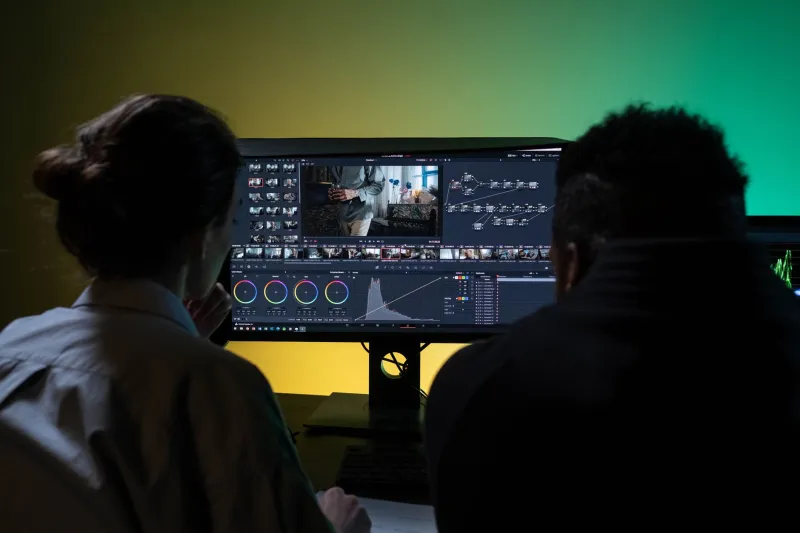
High-end colorists work in DaVinci Resolve's dedicated color page, using tools like curves, qualifiers, and nodes to build complex looks that can be applied consistently across an entire scene or series. The difference between a properly graded scene and one that received a quick auto-correction is immediately visible to any viewer, even if they couldn't articulate exactly why one looks better than the other.
Audio: The Detail That Destroys Immersion When It's Wrong
Post-production audio in adult content doesn't get talked about nearly enough. Bad audio — hiss, hum, clipping, inconsistent levels — is one of the fastest ways to pull a viewer completely out of the experience. And yet it's one of the most commonly neglected elements in lower-budget productions.
Premium platforms invest in proper audio finishing, which means noise reduction, level balancing, and sometimes light sweetening to ensure the sonic environment feels consistent and clean. "Viewers will tolerate a lot of visual imperfections before they'll tolerate bad audio," notes one finishing editor. "It's almost subconscious. If the sound feels off, the whole thing feels off."
Quality Control: The Last Line of Defense
Before any piece of premium content gets delivered to a platform, it goes through quality control — a systematic review process that checks for technical issues like dropped frames, compression artifacts, audio sync problems, and metadata errors. On a well-run production, QC is treated as a non-negotiable final step, not an afterthought.
This is another area where amateur content often falls short. Without a dedicated QC pass, small errors that would have been easily caught and corrected end up in the final deliverable — and end up on screen in front of paying viewers.
The Invisible Art
Here's the thing about great post-production: when it's done right, you don't notice it. You just notice that a scene feels incredible, that you were completely absorbed for however long it ran, that you'd happily watch more content from that same producer. The craft is invisible by design.
But that invisibility is exactly what makes it so valuable. Every premium platform competing for viewer attention is ultimately competing on the quality of the experience they deliver. And a huge part of that experience is built not on set, but in the editing bay, by professionals whose names rarely appear anywhere near the content they help create.
Next time you're streaming something from your favorite platform and everything just clicks — the pacing feels right, the image looks stunning, the audio is clean and immersive — take a second to appreciate the people who made that happen. They were there long after the cameras went dark, making sure your experience was exactly what it should be.